Hello fellow Classmates my name is Tobias B, and today I shall be blogging about the Families of Polynomial functions.
When talking about a family of a polynomial function, we are talking about the general equation of the function. The general equation of a polynomial function is considered as the "family" because it is an equation that represents the function as a whole. However there is also the different family members of the polynomial function. When talking about a family member of a polynomial function, we are talking about a specific point that is located within the family function. The family member function is specific to itself, for no other members in the family can have the same points.
For example:
Family Function:
y= k(x^4-8x^3-2x^2+120x-175)
A specific family member:
9.6=k((3)^4-8(3)^3-2(3)^2+120(3)-175)
9.6=k(32)
0.3=K
y=o.3(x^4-8x^3-2x^2+120x-175)
Sunday, October 11, 2009

Thursday, October 8, 2009
How to use synthetic and factor theorem in application question and hard homework questions.
Hi…..today we didn’t learn much so I’m just going to go over the homework we took up in class today and the word problem we had at the end of the class
There were 2 main questions that people didn’t get, number 9 and 18.
Number 9:
Question: x^3 -2kx^2 + 6x -4 is divisible by (x+ 2) with a remainder of 0. Find the value of k
We discussed two ways to figure out this problem.
First method:
(x+2) = 0
x = -2
so f(-2) = 0 for the equation of x^3 -2kx^2 + 6x -4
then we plug in (-2) in for all the “x”s in the equation
0 = (-2)^3 - 2k(-2)^2 + 6(-2) -4
Solve for k
k = (-8-12-4) /8
k = -3
and that’s how you do it for this method
This second method was thought up by Sharon (I think).
Her way is basically doing synthetic backwards. Since we know that the remainder is going to be 0 then the last number should be 0. So we set up the synthetic like we always do, but this time we know the remainder ahead of time.
-2 | 1 -2k +6 -4
+
------------------------
0R
In order for the remainder to be 0 some number plus -4 has to equal 0. So obviously that number is +4.
So:
-2 | 1 -2k +6 -4
+ 4
--------------------------
0R
So now we divide 4 by -2 (since we are doing it backwards), which is -2. So something plus +6 has to equal 2 which is -8
-2 | 1 -2k +6 -4
+ -8 +4
------------------------
-2 0R
So now we do the same thing as above and take (-8) from the second row and divide it by (-2) which gives us +4 so now we need to add something to -2k to make it +4. But we can’t know what is “k’ yet, so how can we possibly find something that would add up with -2k to equal +4. So we look more to the left and we realize that we can just bring the 1 down.
+ -8 +4
-----------------------------
1 +4 -2 0R
Since we had the one on the bottom we can use it to do synthetic the right way again (not backwards). So we bring the 1 down and multiply it by 2 so we get 2, which we place in the empty under the -2k
-2 | 1 -2k +6 -4
+ - 2 -8 +4
--------------------------------
1 +4 -2 0R
Now that we completed the synthetic with a unknown value (-2k) we can use this to find the unknown. We know that -2k - 2 = 4
-2k - 2 = 4
k= (4+2)(-0.5)
k= -3
And that is the second method=)
Number 18
Question: f(x) = 2x^3 + mx^2 + nx -3 and f(x) = x^3 -3mx^2 + 2n +4 both can be divided by (x-2) with a remainder of 0
First we sub in +2 for all the “x”s.
f(x) = 2x^3 + mx^2 + nx -3
f(2) = 16 + 4m + 2n -3
0 = 4m + 2n + 13
and
f(x) = x^3 -3mx^2 + 2n +4
f(2)= 8 – 12m + 4n + 4
0= 12m - 4n -12
We have two unknowns and two equation so now we can use substitution or elimination or whatever thing you want to use. I like using elimination because in substitution it is easier to make mistakes. ( I think, I don’t know about you). So I’ll use elimination by first setting it up.
12m – 4n -12 = 0
4m + 2n + 13 = 0
I then multiply the second equation (bottom one) by 2.
12m – 4n -12 = 0
+ 8m + 4n + 26 = 0(this one was mutiplied by 2)
20m + 0n 14 = 0
Now that we have only one unknown we can solve for it.
20m + 14 = 0
m = -14/20
Then we sub “m” back into one of the equation to find “n”
12(-14/20) -4n -12 = 0
-4n = 12 - 12(-14/20)
n = -[12 – 12(-14/20)]/4
n = -5.1
Therefore the value of m is -0.7 or -14/20 and the value of n is -5.1
The question from today’s lesson that we did in class:
It said that the volume in cm^3 of ice can be represented by the function of
V(x) = 9x^3 + 60^2 + 249x, where x represents the thickness of the ice block in cm.
It wants you to find the maximum thickness of this ice sculpture can have with a volume of 2532 cm^3.
2532cm^3 I the volume is represented by this V(x). So 2532cm^3 = V(x).
So:
2532 = 9x^3 + 60^2 + 249x
9x^3 + 60^2 + 249x -2532 = 0
Now you just use the factor theorem to find a root of the function. We found in class that (x-4) was a root. So now we do synthetic dividing 9x^3 + 60^2 + 249x -2532 by (x-4)
4| 9 60 249 -2532
+ 36 384 2532
-----------------------------
9 96 633 0R
so the factored form of 9x^3 + 60^2 + 249x -2532 = 0 would be:
= (x – 4)(9x^2+96x+633)
= 3(x – 4) (3x^2+32x+211)
from the we can tell that (3x^2+32x+211) is not factorable.
x = [-32 +/- [(32^2 – (4)(3)(211)]^0.5]/ (2)(3)
x = [-32 +/- [(1024 – 2532]^0.5]/ 6
x = [-32 +/- (-1508)^0.5]/ 6
right now for our level of math we cannot take the root of a negative number. In this case -1508. So there is only one real root of 9x^3 + 60^2 + 249x -2532 = 0 and that root is 4 so the maximum thickness of the block when the volume is 2532cm^3 is 4inches.
THE END
2.3: Polynomial Equations - Period 3/4
Polynomial Equations
Today we quickly learned how to turn polynomial functions into polynomial equations. Using the example from the class, V(x) = 9x^3 + 60x^2 + 249x with the given volume of 2532 cm^3, we find the maximum thickness of a block of ice.
First, we set up the equation:
V = 2532
V(x) = 9x^3 + 60x^2 + 249x
2532 = 9x^3 + 60x^2 + 249x
0 = 9x^3 + 60x^2 + 249x - 2532
Next, we use the factor theorem to determine if there are any integral roots:
0 = (x-4)(9x^2 + 96x + 633)

Since it is not a real root it is, therefore, the max thickness the block can be is 4 cm.
Comment if there are any errors within the post.
Today we quickly learned how to turn polynomial functions into polynomial equations. Using the example from the class, V(x) = 9x^3 + 60x^2 + 249x with the given volume of 2532 cm^3, we find the maximum thickness of a block of ice.
First, we set up the equation:
V = 2532
V(x) = 9x^3 + 60x^2 + 249x
2532 = 9x^3 + 60x^2 + 249x
0 = 9x^3 + 60x^2 + 249x - 2532
Next, we use the factor theorem to determine if there are any integral roots:
- we fine that f(4) = 0
- we use either synthetic division or long division.
0 = (x-4)(9x^2 + 96x + 633)

Since it is not a real root it is, therefore, the max thickness the block can be is 4 cm.
Comment if there are any errors within the post.
Wednesday, October 7, 2009
2.2 The Factor Theorem, Synthetic Division, and the Difference and Sum of Cubes
Synthetic Division
Synthetic Division is a shortcut for long division of polynomials. It saves time, energy, effort, and paper, and because math homework consumes a lot of all of these limited resources, it is in our best interest to use this efficient method of dividing polynomials.
We begin with an equation, the dividend. Ensure the dividend is in order of descending exponents.

Take the divisor, set it equal to zero, and isolate x.
0 = x + 2
-2 = x
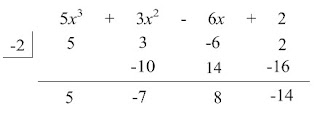
Synthetic division will take four lines. On the left side of the second line, write -2 inside a _|. This will be the multiplier. On the first line, indented so that it is not over the -2, write the dividend with plenty of space between the terms.
In the end, we will have this:
How? Using a different diagram for easier understanding, we can see the process:
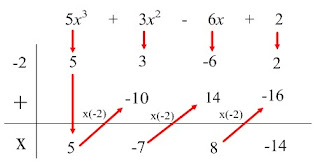
(A) Bring down the coefficients of each term, and the constant, in the same order as they are already in.
(B) The leftmost number is brought down and written. [It is the same as 5 + 0, as 0 is the previous term's coefficient (0x^4)].
(C) The sum is multiplied by -2 (or whatever number is in the corner) and written below the next number.
(D) The number you just wrote is added to the number above it, and written under the line.
The numbers, in order, are 5, -7, 8, and -14. The rightmost number is the remainder. The one to the left of it is the constant, the one to the left of that is the coefficient of the x-value, and the one to the left of that is the coefficient of the x^2 value. The quotient is 5x^2 - 7x + 6 with a remainder of -14.
Therefore the equation is
5x^3 + 3x^2 - 6x + 2 = (x - 2)(5x^2 - 7x + 6) - 14
This is the Burchat Method of Synthetic Division. Alternatively, we can use the Textbook Method of Synthetic Division (found on pg 98 of your textbook).
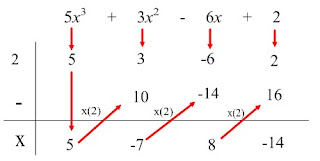
When using the TMoSD, we don't have to find the x-value that ensures x + n = 0 is true. Instead, n is taken in its current form and used. Then, in step (D), the numbers in the third line are subtracted from the numbers in the second line.
The Factor Theorem
The factor theorem is a shortcut to finding the factors of a polynomial.
It goes like this:
"If x = a is substituted into a polynomial for x and the remainder is 0, then (x - a) is a factor of the polynomial."
We can use the remainder theorem to determine whether the remainders of the factors are zero.
The equation is f(x) = x^3 + 2x^2 - x - 2.
f(3) = 3^3 + 2(3)^2 - 3 - 2
f(3) = 27 + 18 - 3 - 2
f(3) = 40
.: (x-3) is not a factor
f(2) = 2^3 + 2(2)^2 - 2 - 2
f(2) = 8 + 8 - 2 - 2
f(2) = 12
.: (x-2) is not a factor
f(1) = 1^3 + 2(1)^2 - 1 - 2
f(1) = 1 + 2 - 1 - 2
f(1) = 0
.: (x-1) is a factor
f(0) = 0^3 + 2(0)^2 - 0 - 2
f(0) = 0 + 0 - 0 - 2
f(0) = -2
.: x is not a factor
f(-1) = (-1)^3 + 2(-1)^2 - (-1) - 2
f(-1) = -1 + 2 + 1 - 2
f(-1) = 0
.: (x+1) is a factor
f(-2) = (-2)^3 + 2(-2)^2 - (-2) - 2
f(-2) = -8 + 8 + 2 - 2
.: (x+2) is a factor
f(-3) = (-3)^3 + 2(-3)^2 - (-3) - 2
f(-3) = -27 + 18 + 3 - 2
f(-3) = -8
.: (x+3) is not a factor.
The factors are (x + 1), (x - 1), and (x + 2).
We can check by multiplication:
(x + 1)(x - 1)(x + 2)
= (x^2 - x + x - 1)(x + 2)
= (x^2 - 1)(x + 2)
= x^3 + 2x^2 - x - 2
While it may seem that it could take forever to find the factors, because you could plug in any number as the a-value, you can cut down the number of possibilities. The -a-value is always a factor of the constant in the polynomial. The -a-values all, when multiplied by each other, equal the constant.
Why does this work? Remember that the zeroes are also the roots, or the x-intercepts, of the polynomial graph. Where y=0, the x-value (x=a) is the x-intercept.
Difference and Sum of Cubes
Like a difference of squares, there is an easy way to find the factors of a difference of cubes. In addition, we can do the same with a sum of cubes.
First, the polynomial must be identified as a sum or difference of cubes. The first step is to look between the two terms and determine which sign separates them. The following rules are only applicable if the sign is + or -, and there are separate but similar rules for addition and subtraction. Then the terms must be identified as cubes, which can be done by finding the cube root of each term and seeing if they are integers. This is also useful because the cube roots will be used in the process of finding the factors.
The following equation is used to find the difference of cubes:

The following equation is used to find the sum of cubes:

As you can see, the equations are very similar. It is important not to mix them up.
For the example, we will use the equation 64x^3 - 125.
Following the equation above,
a^3 = 64x^3
b^3 = 125
By finding the cube root of 64x^3 and 125, we can find the a and b values. In this case,
a = 4x
b = 5.
First, to find the difference of these cubes,
Sub a^3 = 64x^3, b^3 = 125, a = 4x, and b = 5 into a^3 - b^3 = (a - b)(a^2 + ab + b^2)
64x^3 - 125 = (4x - 5)[(4x)^2 + (4x)(5) + 5^2]
64x^3 - 125 = (4x - 5)(16x^2 + 20x + 25)
Next, to find the sum of these cubes,
Sub a^3 = 64x^3, b^3 = 125, a = 4x, and b = 5 into a^3 + b^3 = (a + b)(a^2 - ab + b^2)
64x^3 + 125 = (4x + b)[(4x)^2 - (4x)(5) + 5^2]
64x^3 - 125 = (4x + 5)(16x^2 - 20x + 25)
Synthetic Division is a shortcut for long division of polynomials. It saves time, energy, effort, and paper, and because math homework consumes a lot of all of these limited resources, it is in our best interest to use this efficient method of dividing polynomials.
We begin with an equation, the dividend. Ensure the dividend is in order of descending exponents.

Take the divisor, set it equal to zero, and isolate x.
0 = x + 2
-2 = x
Synthetic division will take four lines. On the left side of the second line, write -2 inside a _|. This will be the multiplier. On the first line, indented so that it is not over the -2, write the dividend with plenty of space between the terms.
In the end, we will have this:

How? Using a different diagram for easier understanding, we can see the process:

(A) Bring down the coefficients of each term, and the constant, in the same order as they are already in.
(B) The leftmost number is brought down and written. [It is the same as 5 + 0, as 0 is the previous term's coefficient (0x^4)].
(C) The sum is multiplied by -2 (or whatever number is in the corner) and written below the next number.
(D) The number you just wrote is added to the number above it, and written under the line.
The numbers, in order, are 5, -7, 8, and -14. The rightmost number is the remainder. The one to the left of it is the constant, the one to the left of that is the coefficient of the x-value, and the one to the left of that is the coefficient of the x^2 value. The quotient is 5x^2 - 7x + 6 with a remainder of -14.
Therefore the equation is
5x^3 + 3x^2 - 6x + 2 = (x - 2)(5x^2 - 7x + 6) - 14
This is the Burchat Method of Synthetic Division. Alternatively, we can use the Textbook Method of Synthetic Division (found on pg 98 of your textbook).
When using the TMoSD, we don't have to find the x-value that ensures x + n = 0 is true. Instead, n is taken in its current form and used. Then, in step (D), the numbers in the third line are subtracted from the numbers in the second line.

The Factor Theorem
The factor theorem is a shortcut to finding the factors of a polynomial.
It goes like this:
"If x = a is substituted into a polynomial for x and the remainder is 0, then (x - a) is a factor of the polynomial."
We can use the remainder theorem to determine whether the remainders of the factors are zero.
The equation is f(x) = x^3 + 2x^2 - x - 2.
f(3) = 3^3 + 2(3)^2 - 3 - 2
f(3) = 27 + 18 - 3 - 2
f(3) = 40
.: (x-3) is not a factor
f(2) = 2^3 + 2(2)^2 - 2 - 2
f(2) = 8 + 8 - 2 - 2
f(2) = 12
.: (x-2) is not a factor
f(1) = 1^3 + 2(1)^2 - 1 - 2
f(1) = 1 + 2 - 1 - 2
f(1) = 0
.: (x-1) is a factor
f(0) = 0^3 + 2(0)^2 - 0 - 2
f(0) = 0 + 0 - 0 - 2
f(0) = -2
.: x is not a factor
f(-1) = (-1)^3 + 2(-1)^2 - (-1) - 2
f(-1) = -1 + 2 + 1 - 2
f(-1) = 0
.: (x+1) is a factor
f(-2) = (-2)^3 + 2(-2)^2 - (-2) - 2
f(-2) = -8 + 8 + 2 - 2
.: (x+2) is a factor
f(-3) = (-3)^3 + 2(-3)^2 - (-3) - 2
f(-3) = -27 + 18 + 3 - 2
f(-3) = -8
.: (x+3) is not a factor.
The factors are (x + 1), (x - 1), and (x + 2).
We can check by multiplication:
(x + 1)(x - 1)(x + 2)
= (x^2 - x + x - 1)(x + 2)
= (x^2 - 1)(x + 2)
= x^3 + 2x^2 - x - 2
While it may seem that it could take forever to find the factors, because you could plug in any number as the a-value, you can cut down the number of possibilities. The -a-value is always a factor of the constant in the polynomial. The -a-values all, when multiplied by each other, equal the constant.
Why does this work? Remember that the zeroes are also the roots, or the x-intercepts, of the polynomial graph. Where y=0, the x-value (x=a) is the x-intercept.
Difference and Sum of Cubes
Like a difference of squares, there is an easy way to find the factors of a difference of cubes. In addition, we can do the same with a sum of cubes.
First, the polynomial must be identified as a sum or difference of cubes. The first step is to look between the two terms and determine which sign separates them. The following rules are only applicable if the sign is + or -, and there are separate but similar rules for addition and subtraction. Then the terms must be identified as cubes, which can be done by finding the cube root of each term and seeing if they are integers. This is also useful because the cube roots will be used in the process of finding the factors.
The following equation is used to find the difference of cubes:

The following equation is used to find the sum of cubes:

As you can see, the equations are very similar. It is important not to mix them up.
For the example, we will use the equation 64x^3 - 125.
Following the equation above,
a^3 = 64x^3
b^3 = 125
By finding the cube root of 64x^3 and 125, we can find the a and b values. In this case,
a = 4x
b = 5.
First, to find the difference of these cubes,
Sub a^3 = 64x^3, b^3 = 125, a = 4x, and b = 5 into a^3 - b^3 = (a - b)(a^2 + ab + b^2)
64x^3 - 125 = (4x - 5)[(4x)^2 + (4x)(5) + 5^2]
64x^3 - 125 = (4x - 5)(16x^2 + 20x + 25)
Next, to find the sum of these cubes,
Sub a^3 = 64x^3, b^3 = 125, a = 4x, and b = 5 into a^3 + b^3 = (a + b)(a^2 - ab + b^2)
64x^3 + 125 = (4x + b)[(4x)^2 - (4x)(5) + 5^2]
64x^3 - 125 = (4x + 5)(16x^2 - 20x + 25)
2.2 The Factor Theorem- Dividing Polynomails using Synthetic Division


If you have any questions feel free to post them.
2.1 Division of Polynomials & the Remainder Theorem - Period 3
Hi everyone!
Chapter 1 on polynomial functions is finally over and starting from today we will look at polynomial equations and inequalities. In this lesson, we have learned how to reuse grade 4 mathematics – long division to divide a polynomial by a binomial and ‘remainder theorem’ to determine the remainder of the polynomial without dividing it.
So now let’s recall the long division we learned in grade 4:
 Here, ‘42’ at the left will be the ‘divisor’;
‘6487’ at the centre will be the ‘dividend’;
‘154’ at the top will be the ‘quotient’ which the answer is needed to be in perfect columns; and
‘19’ at the bottom and has a letter ‘R’ representing it will the remainder of the expression.
Therefore, we can say:
Method 1(provided by our teacher): x³-6x²+4x+1 = (x-3)(x²-3x-5)-14
Or
Method 2 (provided our textbook): x³-6x²+4x+1 = (x²-3x-5)(-14/(x-3))
How about those with some terms missing?
2. Divide x⁴-2x²+1 by x+2 (we can notice that the ’x³’ term and the ‘x’ term are missing!)
[In fact, we can insert terms with the value of ‘0’ into the equation. That is:
x⁴-2x²+1 → x⁴+0x³-2x²+0x+1]
 This time, since there is no remainder both methods 1 and 2 can get the same form of answer.
Therefore, x⁴-2x²+1 divided by x+2 = (x+2)(x³-2x²+2x-4)
→ This is how long divisions of polynomials works.
Now, let’s try out the remainder theorem.
Before we start, let’s do an experiment.
a) Divide x³-4x²+3x-13 by x+4
b) Find f(-4)
 b. f(x) = x³-4x²+3x-13
f(-4) = (-4)³-4(-4)²+3(-4)-13
=-153
→ Because both (a) and (b) get the same answer, we can deduce that:
When a polynomial function P(x) is divided by (x-b), the remainder is P(b), and when it is divided by ax-b, the remainder is P(b/a), where a and b are integers and a≠0.
Let's try one more example: Find the remainder of x³+2x²-13x+1 when it is divided by x-1
→ x-1=0
x=1
(1)³+2(1)²-13(1)+1
=1+2-13+1
=-9
Therefore, when x³+2x²-13x+1 is divided by x-1, the remainder will be -9.
This is the end of the lesson, hope you will find it helpful! :)
If there is anything with my entry, please feel free to tell me.
Chapter 1 on polynomial functions is finally over and starting from today we will look at polynomial equations and inequalities. In this lesson, we have learned how to reuse grade 4 mathematics – long division to divide a polynomial by a binomial and ‘remainder theorem’ to determine the remainder of the polynomial without dividing it.
So now let’s recall the long division we learned in grade 4:
Divide 6487 by 42.
Here, ‘42’ at the left will be the ‘divisor’;‘6487’ at the centre will be the ‘dividend’;
‘154’ at the top will be the ‘quotient’ which the answer is needed to be in perfect columns; and
‘19’ at the bottom and has a letter ‘R’ representing it will the remainder of the expression.
In that case, 6487=154(42)+19
→That is, dividend=(divisor)(quotient)+remainder
Let’s try some real ones:
1. Divide x³-6x²+4x+1 by x-3
[Important point to note: the terms of the equation must always be in descending order during calculation] (The subtract signs along the side of the long division are just to indicate that subtraction is going on between the expressions.)
1. Divide x³-6x²+4x+1 by x-3
[Important point to note: the terms of the equation must always be in descending order during calculation]
(The subtract signs along the side of the long division are just to indicate that subtraction is going on between the expressions.)Therefore, we can say:
Method 1(provided by our teacher): x³-6x²+4x+1 = (x-3)(x²-3x-5)-14
Or
Method 2 (provided our textbook): x³-6x²+4x+1 = (x²-3x-5)(-14/(x-3))
How about those with some terms missing?
2. Divide x⁴-2x²+1 by x+2 (we can notice that the ’x³’ term and the ‘x’ term are missing!)
[In fact, we can insert terms with the value of ‘0’ into the equation. That is:
x⁴-2x²+1 → x⁴+0x³-2x²+0x+1]
This time, since there is no remainder both methods 1 and 2 can get the same form of answer.Therefore, x⁴-2x²+1 divided by x+2 = (x+2)(x³-2x²+2x-4)
→ This is how long divisions of polynomials works.
Now, let’s try out the remainder theorem.
Before we start, let’s do an experiment.
a) Divide x³-4x²+3x-13 by x+4
b) Find f(-4)
b. f(x) = x³-4x²+3x-13f(-4) = (-4)³-4(-4)²+3(-4)-13
=-153
→ Because both (a) and (b) get the same answer, we can deduce that:
When a polynomial function P(x) is divided by (x-b), the remainder is P(b), and when it is divided by ax-b, the remainder is P(b/a), where a and b are integers and a≠0.
Let's try one more example: Find the remainder of x³+2x²-13x+1 when it is divided by x-1
→ x-1=0
x=1
(1)³+2(1)²-13(1)+1
=1+2-13+1
=-9
Therefore, when x³+2x²-13x+1 is divided by x-1, the remainder will be -9.
This is the end of the lesson, hope you will find it helpful! :)
If there is anything with my entry, please feel free to tell me.
Monday, October 5, 2009
2.1 Division of Polynomials & the Remainder Theorem
Long Division Basics
To know how to divide polynomials, you need to know how to perform long division - a technique which we learned many many years ago. So if you forgot, you're already behind. But I won't get into that; I'll assume you know it. If not then here's a link:
http://argyll.epsb.ca/jreed/extras/longdiv/
Is it a good link? Who knows!? I Googled it and I was feeling lucky.
It's also important to know some of the vocabulary when dividing polynomials.
We can use the following example:
* 14x^4 + 0x^3 -3x^2 + 0x + 9 is the dividend
* x+3 is the divisor
* 14x^3 -42x^2 +123x -369 is the quotient
* 1116R is the remainder

Dividing Polynomials
To divide polynomials, you first have to identify the dividend and the divisor. Once they are identified you can now divide the dividend by the divisor using long division.
Dividing a polynomial is similar to dividing a number using long division... You check to see how many times a divisor can go into a dividend by dividing sections of the dividend by the divisor. For polynomials, you do this one term at a time, starting with the term with the largest exponent. Let's start with a tricky one:
1. This one's tricky because the question provided doesn't have an x^3-term or an x-term within the polynomial. In order to continue with this question "placeholders" are required.
 Placeholders: Terms that are equivalent to 0 so that it doesn't have an effect on the polynomial itself, yet it allows the polynomial to be divided.
Another thing to watch out for are polynomials that are "out of order." Make sure the terms always go from highest to lowest exponents like so: (x^5 + x^4 + x^3 + x^2 + x + 9999)
2. Ask: How many times can the divisor (x+3) go into the dividend (14x^4)? The answer is 14x^3 times. Therefore, 14x^3 becomes the first term of the quotient and it's placed directly above 0x^3 (found in the dividend) because they are like-terms (this is important for proper communication).
Because (x+3)(14x^3) = 14x^4... you place 14x^4 below the first term of the dividend and subtract the two terms. The difference will always be 0... or else you did something wrong!
3. This is where you use the other part of the divisor, the 3 in this case. You multiply it by the same amount of times we multiplied the x-variable from step 2. SO... you multiply 3 by 14x^3 which = 42x^3. You place this directly below its like-term from the dividend (0x^3) and then you subtract the two terms.
4. Yay! We're done with the first term! Where to look next? The second term of the dividend? Nope. You use the answer which you got from step 3 (-42x^3) and divide that by you divisor (x+3). Solve: How many times does x+3 go into -42x^3?? Once you find your answer, it becomes the second term of your quotient... Simply repeat steps 2-3.
Continue to do this process until you reach the last term and eventually:
<= If there was a remainder of 0 then the divisor (x+3) would be known as an Even/Perfect Factor.
Division Statements
Once you're done all that dividing stuff, you'll need to summarize by using something known as a Division Statement.
Division Statement: Dividend = (Divisor)(Quotient) + Remainder.
So using the example that's been used the whole time above, the division statement would look like:
14x^4 - 3x^2 + 9 = (x+3)(14x^3 - 42x^2 +123x -369) + 1116.
Note: The remainder doesn't end with "R" so that we don't confuse it to be a variable.
This is not only useful for summarizing your work, but also can be used for word problems and for future calculations... (The Remainder Theorem!!!!)
Remainder Theorem
States that if you divide P(x) by (x-a), then the remainder will be the same as P(a).
This is assuming that a = the value which makes the divisor=0.
Therefore, if x=a then x-a = 0 (because a-a = 0 DUHH).
(Remember: (divisor) (quotient) + remainder... So if the quotient is 0, it automatically makes the DIVISOR 0 and you're left with the remainder, so you don't have to go through long division to figure out what the remainder is)
Let's make the divisor x+2
And the quotient P(x) = 2x^3 + 7x^2 -x + 1.
1. Think about what value of x would make the divisor = 0. In this case, that number would be -2.
2. Plug that number into the "function machine." P(-2) = 2(-2)^3 + 7(-2)^2 - (-2) + 1
3. Solve the function. The result is the remainder. P(-2) = 15R
So far in class, we've been using polynomials as the quotient and binomials as the divisor. As long as you have these 2 elements, the 3 steps above will definitely work.
Using Remainder Theorem to Solve Problems With 2 Variables
Polynomials with 2 variables may be intimidating at first, but are actually very simple to solve when you have:
- A divisor
- The remainder
Ex. Pg.92 #10a.
Determine the value of k such that when P(x) = kx^3 + 5x^2 - 2x + 3 is divided by x+1, the remainder is 7.
1. Think about what value of x would make the divisor = 0. In this case, that number would be -1.
2. Plug that number into the "function machine." You must also state that P(-1)=Remainder before you start to solve for "k". This would not only allow you to plug -1 into the function, but will also allow you to solve for the variable "k". P(-1) = 7.
3. Solve for "k". k=3
10b: Determine the remainder when P(x) is divided by x-3.
This is straight up Remainder Theorem because you solved for "k". Follow the 3 steps given to you in the "Remainder Theorem" section to solve this.
-----
FINALLY DONE! I apologize for my lateness, the post's length, and perhaps for a confusing scribe post. Today's lesson was very heavy content wise... So if you find any errors in this post please comment NICELY! :D
And I'll fix it when I have time. :)
To know how to divide polynomials, you need to know how to perform long division - a technique which we learned many many years ago. So if you forgot, you're already behind. But I won't get into that; I'll assume you know it. If not then here's a link:
http://argyll.epsb.ca/jreed/extras/longdiv/
Is it a good link? Who knows!? I Googled it and I was feeling lucky.
It's also important to know some of the vocabulary when dividing polynomials.
We can use the following example:
* 14x^4 + 0x^3 -3x^2 + 0x + 9 is the dividend
* x+3 is the divisor
* 14x^3 -42x^2 +123x -369 is the quotient
* 1116R is the remainder

Dividing Polynomials
To divide polynomials, you first have to identify the dividend and the divisor. Once they are identified you can now divide the dividend by the divisor using long division.
Dividing a polynomial is similar to dividing a number using long division... You check to see how many times a divisor can go into a dividend by dividing sections of the dividend by the divisor. For polynomials, you do this one term at a time, starting with the term with the largest exponent. Let's start with a tricky one:
1. This one's tricky because the question provided doesn't have an x^3-term or an x-term within the polynomial. In order to continue with this question "placeholders" are required.
 Placeholders: Terms that are equivalent to 0 so that it doesn't have an effect on the polynomial itself, yet it allows the polynomial to be divided.
Another thing to watch out for are polynomials that are "out of order." Make sure the terms always go from highest to lowest exponents like so: (x^5 + x^4 + x^3 + x^2 + x + 9999)
2. Ask: How many times can the divisor (x+3) go into the dividend (14x^4)? The answer is 14x^3 times. Therefore, 14x^3 becomes the first term of the quotient and it's placed directly above 0x^3 (found in the dividend) because they are like-terms (this is important for proper communication).

Because (x+3)(14x^3) = 14x^4... you place 14x^4 below the first term of the dividend and subtract the two terms. The difference will always be 0... or else you did something wrong!
3. This is where you use the other part of the divisor, the 3 in this case. You multiply it by the same amount of times we multiplied the x-variable from step 2. SO... you multiply 3 by 14x^3 which = 42x^3. You place this directly below its like-term from the dividend (0x^3) and then you subtract
 the two terms.
4. Yay! We're done with the first term! Where to look next? The second term of the dividend? Nope. You use the answer which you got from step 3 (-42x^3) and divide that by you divisor (x+3). Solve: How many times does x+3 go into -42x^3?? Once you find your answer, it becomes the second term of your quotient... Simply repeat steps 2-3.
Continue to do this process until you reach the last term and eventually:
<= If there was a remainder of 0 then the divisor (x+3) would be known as an Even/Perfect Factor.
Division Statements
Once you're done all that dividing stuff, you'll need to summarize by using something known as a Division Statement.
Division Statement: Dividend = (Divisor)(Quotient) + Remainder.
So using the example that's been used the whole time above, the division statement would look like:
14x^4 - 3x^2 + 9 = (x+3)(14x^3 - 42x^2 +123x -369) + 1116.
Note: The remainder doesn't end with "R" so that we don't confuse it to be a variable.
This is not only useful for summarizing your work, but also can be used for word problems and for future calculations... (The Remainder Theorem!!!!)
Remainder Theorem
States that if you divide P(x) by (x-a), then the remainder will be the same as P(a).
This is assuming that a = the value which makes the divisor=0.
Therefore, if x=a then x-a = 0 (because a-a = 0 DUHH).
(Remember: (divisor) (quotient) + remainder... So if the quotient is 0, it automatically makes the DIVISOR 0 and you're left with the remainder, so you don't have to go through long division to figure out what the remainder is)
Let's make the divisor x+2
And the quotient P(x) = 2x^3 + 7x^2 -x + 1.
1. Think about what value of x would make the divisor = 0. In this case, that number would be -2.
2. Plug that number into the "function machine." P(-2) = 2(-2)^3 + 7(-2)^2 - (-2) + 1
3. Solve the function. The result is the remainder. P(-2) = 15R
So far in class, we've been using polynomials as the quotient and binomials as the divisor. As long as you have these 2 elements, the 3 steps above will definitely work.
Using Remainder Theorem to Solve Problems With 2 Variables
Polynomials with 2 variables may be intimidating at first, but are actually very simple to solve when you have:
- A divisor
- The remainder
Ex. Pg.92 #10a.
Determine the value of k such that when P(x) = kx^3 + 5x^2 - 2x + 3 is divided by x+1, the remainder is 7.
1. Think about what value of x would make the divisor = 0. In this case, that number would be -1.
2. Plug that number into the "function machine." You must also state that P(-1)=Remainder before you start to solve for "k". This would not only allow you to plug -1 into the function, but will also allow you to solve for the variable "k". P(-1) = 7.
3. Solve for "k". k=3
10b: Determine the remainder when P(x) is divided by x-3.
This is straight up Remainder Theorem because you solved for "k". Follow the 3 steps given to you in the "Remainder Theorem" section to solve this.
-----
FINALLY DONE! I apologize for my lateness, the post's length, and perhaps for a confusing scribe post. Today's lesson was very heavy content wise... So if you find any errors in this post please comment NICELY! :D
And I'll fix it when I have time. :)
Subscribe to:
Posts (Atom)

 Posts


