5.4 Solving Trigonometric Equations
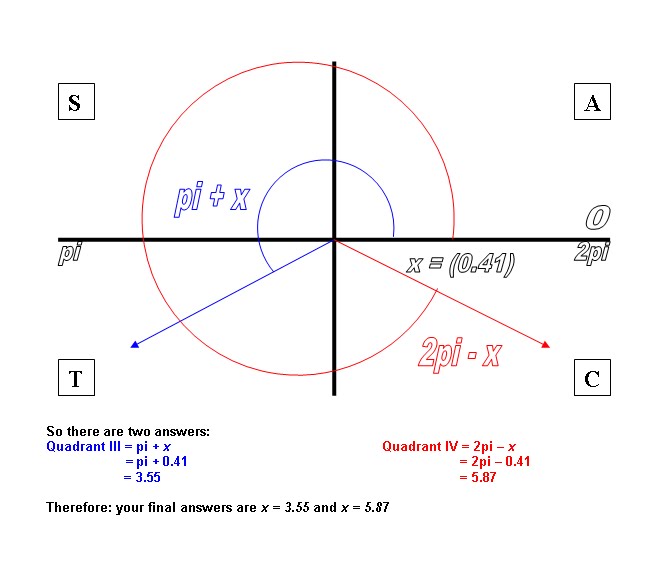
[to solve trig equations, we must find x values which satisfy the equation and are within the stated domain - usually 2pi]
So really sorry everyone, but this blog has a very small width, so I wrote my blog on Word. Click images to enlarge them!
Okay, the next example is REALLY important to pay attention to (helpful on # 9,10,12 in hmwk).
This final example was taught in class by Ms. Burchat and I feel it’s really important to go through for future questions (even though it isn’t needed in Part 1 of 5.4 homework).
Steps to finding an equation from the information given:
1.Finding Amplitude:
To find the amplitude it will always be …
a =max – min
2
Ex. A Ferris Wheel has a max. height of 112.5 m and a diameter of 100m.
Max height = 112.5 m
Min height = 112.5m – 100m = 12.5 m
a =112.5 – 12.5
2
a = 50
2.Finding the Period:
To find the period it will always be one whole cycle/rotation. The ‘k’ value can be found through the period …
period = 2π/k
Ex. It takes 15 min. for one completely rotation of the Ferris Wheel. So the period would be every 15 min.
period = 2π/k
15= 2π/k
k = 2π/15
With the information that is found parts of the equation can be formed. The information that was found on the amplitude and the ‘k’ value applies to both cos and sin graph.
y = 50 sin [2π/15 (t – d)] + c
y = 50 cos [2π/15 (t – d)] + c
3.Finding the C value (vertical translations):
To find the ‘c’ value is the value of the middle point between the max and the min height.
c=max +min
2
Ex. The max and min that was used to find the amplitude of the Ferris Wheel can also be used to find what the ‘c’ value is.
c=max +min
2
c=112.5 + 12.5
2
c=62.5
This ‘c’ value applies to both the cos and sin graph!!
Now adding the ‘c’ value to the equation …
y = 50 sin [2π/15 (t – d)] + 62.5
y = 50 cos [2π/15 (t – d)] + 62.5
4.Finding the ‘d’ value (phrase shift):
The ‘d’ value for both the cos and sin graph are different. One of the ways in finding the ‘d’ value is by looking at the graph.
**graph moving towards the translated graph
Another method to determine the ‘d’ value of the equation is the algebraic method. By substituting the y and t value of each equation with the points already determined from the max/min.
Ex. The Ferris Wheel reaches its maximum height 10 minutes after the wheel begins rotating.
We already know that the maximum height is 112.5m. So in 10 minutes the cart will be at 112.5m. When this information is graphed the y = 112.5 and t = 10. (112.5,10)
Knowing the x and the y value of one point through substitution you would be able to calculate the ‘d’ value.
y = 50 sin [2π/15 (t – d)] + 62.5
let y = 112.5 and x = 10
112.5 = 50 sin [2π/15 (10 – d)] + 62.5
50 = 50 sin [2π/15 (10 – d)]
1 = sin(2π/15)(10 – d)
sin-1(1) = (2π/15)(10 – d)
(15/2π)sin-1(1) = 10 – d
(15/2π)sin-1(1) = 10 – d
-10 + (15/2π)sin-1(1) = – d
10 - (15/2π)sin-1(1) =d
d = 6.25
y = 50 sin [2π/15 (t – 6.25)] + 62.5
y = 50 cos [2π/15 (t – d)] + 62.5
let y = 112.5 and x = 10
112.5 = 50 cos [2π/15 (10 – d)] + 62.5
50 = 50 cos [2π/15 (10 – d)]
1 = cos(2π/15)(10 – d)
cos-1(1) = (2π/15)(10 – d)
(15/2π)cos-1(1) = 10 – d
(15/2π)cos-1(1) = 10 – d
-10 + (15/2π)cos-1(1) = – d
10 - (15/2π)cos-1(1) =d
d = 10
y = 50 cos [2π/15 (t – 10)] + 62.5
To summarize ...
1. the max and min can determine the amplitude of the equation
2. knowing the cycle/period, the 'k' can be determined
3. knowing he middle point between the max and min, the vertical translation can be found
4. by comparing the original cos/sin graph then horizontal translation can be found




 Posts
Posts


