Much like solving any other equation, the goal of solving a trigonometric equation means finding the values of
x that satisfy the equation. If there is a stated domain, the goal is to find the values of
x within that domain. If not, however, you must find all of the values of
x that could possibly satisfy the equation.
For example:
Solve the equation
4 cos x - 1 = 0 within the domain
0 < x < 2.
First, isolate
x, as usual.

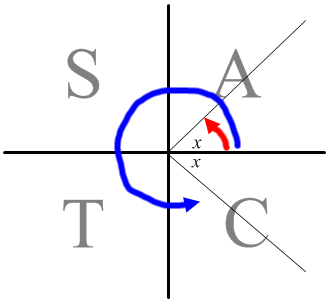
The ratio is positive, so according to the CAST rule, the angle will be in the first and fourth quadrants.
According to the calculator, to the nearest hundredth,
cos^(-1) (1/4) = 1.32 radians. This is the angle from the
x-axis.

Because one solution is in the first quadrant, one solution is 1.32. However, the other solution is in the fourth quadrant, and so 1.32 radians from the
x-axis. The
x-axis represents 2π. Therefore, 2π - 1.32 can be used to find the other solution, 4.96.
The two solutions are
x = 1.32 and
x = 4.96.
A similar process can be used if the ratio was negative, such as in
4 cos x + 1 = 0 within the domain
0 < x < 2. First isolate
x:

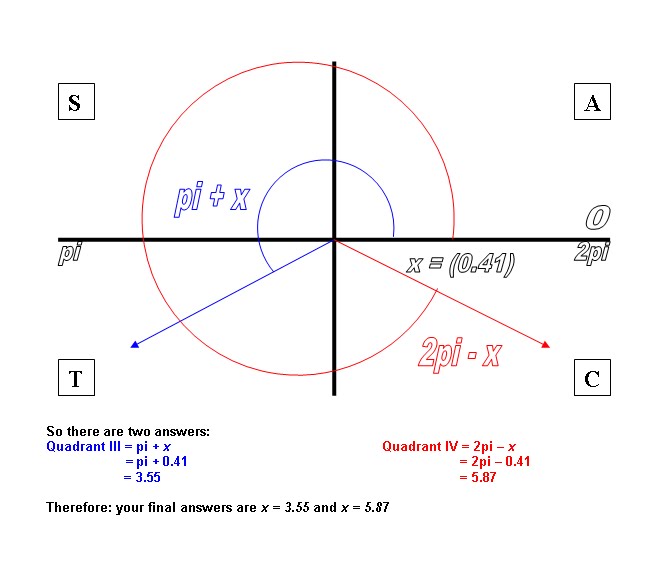
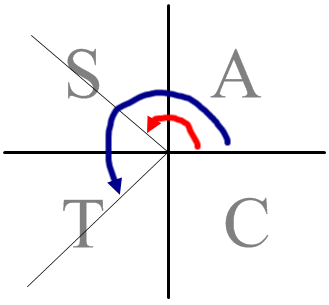
According to CAST, the solutions must be in the second and third quadrants because the ratio is negative. Recall that
cos^(-1) (1/4) = 1.32 radians, and this represents the distance from the
x-axis.

In the second and third quadrants, the
x-axis represents π. In the second quadrant, the angle is 1.32 fewer than π, so to solve for
x, subtract 1.32 from π. π - 1.32 = 1.82.
In the third quadrant, the angle is 1.32 greater than π. To solve for
x, add 1.32 to π. π + 1.32 = 4.45.
The two solutions are
x = 1.82 and
x = 4.45.
Horizontal CompressionsIt won't always be the case that there are only two solutions within the domain. There might, for example, be a horizontal compression, like in
4 cos (2x) - 1 = 0 (domain:
0 < x < 2) Isolate the variable as much as possible.

There is a significant difference between 2.48 and 2π, so it is likely that there are more solutions.
The period of a cosine graph is usually 2π, but since it was horizontally compressed by a factor of 1/2, the new period is just π. This means that π can simply be added to each solution, since the cosine graph will have repeated and be at the same value.
π + 0.66 = 3.80π + 2.48 = 5.62The solutions are therefore
x = 0.66,
x = 2.48,
x = 3.80, and
x = 5.62.
No Stated Domain4 cos (2
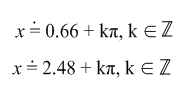
x) - 1 = 0 has been stated above to have a period of π, and π was added to 0.66 and 2.48 to create two new solutions. If there is no domain, π can be added to (or subtracted from) 0.66 or 2.48
ad infinitum.







 Posts
Posts


